You Can't See Radon. You Can Test for It.
Radon is a radioactive gas. It has no color, no smell, and no taste. It is the second leading cause of lung cancer in the United States, and the leading cause among people who have never smoked. You cannot walk through a house and know whether it's there. Testing is the only way.
Starting at $150
Your Neighbor's Test Result Tells You Nothing
Radon levels are driven by the specific soil and rock beneath a specific house, and by how that particular house is built, sealed, and ventilated.
Two homes on the same street, built the same year by the same builder, can test very differently. You cannot predict a level from the age of the home, the neighborhood, the foundation type, or whether the house next door came back low.
New Jersey is not a low-radon state. NJ DEP maintains municipal radon potential tiers, and parts of South Jersey and the surrounding region fall into higher-potential areas.
New Jersey requires radon measurement to be performed by a certified technician, and the protocol matters as much as the equipment — placement, closed-house conditions, duration, and tamper detection all affect whether a result means anything. We use a continuous radon monitor, which records hourly readings rather than producing a single averaged number. That shows us not just the level, but whether the test conditions held.
How It Works
Add It to Your Inspection
Book radon with your home inspection, or on its own for a home you already own.
We Place the Monitor
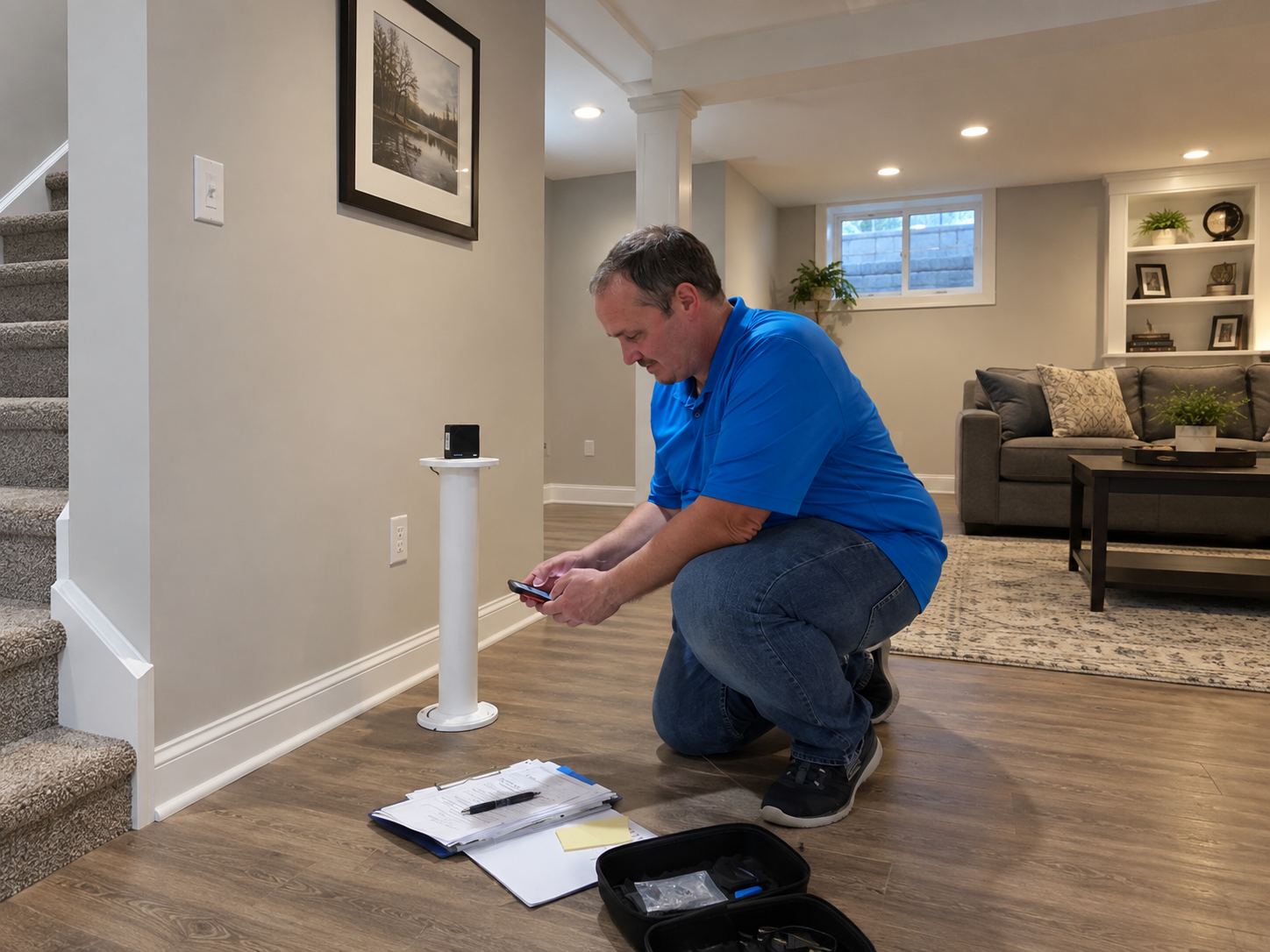
The device goes on the lowest livable level of the home and runs for a minimum of 48 hours under closed-house conditions.
You Get the Numbers
A clear report with your average level, the hourly readings behind it, and a plain explanation of what the result means.
What to Do During the Test
Closed-house conditions are required for the test to be valid. During the monitoring period:
- Keep windows and exterior doors closed, except for normal entry and exit
- Leave the monitor where it was placed — don't move, cover, or unplug it
- Run heating and air conditioning normally
- Avoid running whole-house fans, window fans, or attic fans
- Don't operate a fireplace or wood stove
Understanding Radon
Where it comes from
Uranium occurs naturally in soil and rock. As it breaks down, it produces radon gas, which moves up through the ground and into the air.
How it gets into a home
Through cracks in slabs and foundation walls, gaps around pipe penetrations, sump pits, drain tile, crawlspaces, and sometimes a private well.
Why it matters
Radon decays into particles that lodge in lung tissue. The EPA attributes roughly 21,000 lung cancer deaths a year in the U.S. to radon exposure.
What counts as elevated
The EPA action level is 4.0 pCi/L, and the EPA suggests considering reduction between 2.0 and 4.0. There is no level considered entirely risk-free.
If Your Level Comes Back Elevated
An elevated result is not a reason to walk away from a house. Radon is one of the few home problems with a reliable, permanent, and reasonably priced solution.
A mitigation system — usually sub-slab depressurization, a pipe and fan that vents soil gas above the roofline — routinely brings levels down substantially. Most systems run in the range of $2,000 to $3,000 installed, and in a real estate transaction this is a normal thing to negotiate.
The house isn't disqualified. It just needs a fix — and now you know to ask for it.
What You'll Walk Away With
A real number for your home, measured properly, with the data behind it. A clear sense of whether anything needs to be done. And if it does, a problem with a known, permanent, affordable solution — identified while someone else can still be asked to pay for it.
Frequently Asked Questions
Find Out What's Actually in the Air
Starting at $150. Pricing is subject to change based on property conditions, service requirements, location, and other applicable factors.
Vivid Home Inspections proudly serves homebuyers and homeowners throughout South Jersey, including Camden, Burlington, and Gloucester Counties, as well as Eastern Pennsylvania.
Client Reviews
What Our Clients Say
Real reviews from real home buyers and sellers across South Jersey and Eastern Pennsylvania.
Home Inspections Across South Jersey & Eastern PA
We proudly serve home buyers, sellers, and owners throughout South Jersey and Eastern Pennsylvania. Local expertise means we know the common issues in regional construction, soil, and aging housing stock.
- Burlington County
- Camden County
- Gloucester County
- Salem County
- Mercer County
- Eastern Pennsylvania
Ready for a Vivid, Detailed Home Inspection?
Book online in minutes or call us directly. Certified inspectors, same-day digital reports, and coverage across all of South Jersey and Eastern Pennsylvania — so you can move forward with confidence.
Certified & Insured
InterNACHI certified, NJ licensed & insured.
Same-Day Reports
Detailed, photo-rich findings within 24 hours.
Easy Online Booking
Schedule your inspection in minutes.
Talk to a Real Person
Mon–Fri: 7:00 AM – 6:00 PM | Sat: 8:00 AM – 4:00 PM